
Why Do Cracks Appear in Chromium Carbide Wear Plates?
Are cracks on the surface of chromium carbide overlay wear plates normal?
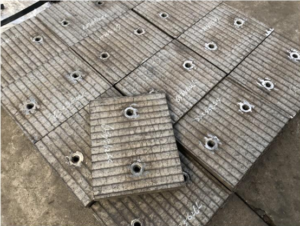
Yes, this is normal. Any chromium carbide overlay wear plate will inevitably develop surface cracks because it consists of one or more layers of chromium carbide hardfacing deposited onto a medium- or low-carbon steel substrate.
👉 CCO vs AR Wear Plates: Which Performs Better in High Abrasion?
Due to the significant difference in thermal expansion coefficients between the base plate and the hardfacing layer, stress is released during the cooling process, resulting in crack formation.
For example, cracks that run perpendicular to the weld bead and are evenly distributed across the surface are a normal characteristic of the hardfacing process. These cracks will not cause the wear-resistant layer to detach and will not affect service life.
What should be of concern are cracks that are excessively wide, excessively long, or those that extend into the base steel substrate.
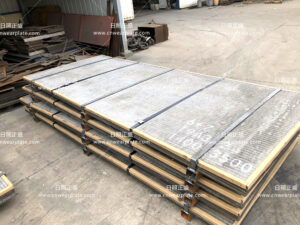
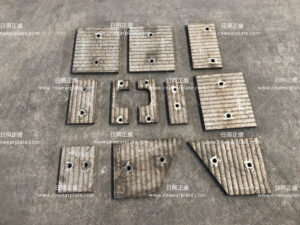
Chromium carbide overlay wear plates are widely used in abrasive environments.
👉 Learn more about wear plate selection in our Wear Plate Guide Hub.
How to distinguish between normal cracks and quality defects?
In welding and hardfacing products, hidden defects can exist beneath the surface. Understanding defect types and inspection criteria is essential for ensuring safe and reliable performance.👉 How to Evaluate Chromium Carbide Overlay Plate?
“Acceptable” cracks (normal condition)
- Even distribution: Cracks form a regular mesh or “tortoise-shell” pattern, evenly distributed across the hardfacing surface
- Fine and shallow: Crack width is typically below 0.5 mm and limited to the overlay layer only, without penetrating the base metal
- Stable (non-propagating): Cracks remain stable during service and do not significantly expand in width or depth
“Unacceptable” cracks (defects)
- Penetrating cracks: Cracks extend from the surface layer into the base steel substrate
- Large macroscopic cracks: Crack width exceeds approximately 1 mm, with irregular and long propagation paths
- Longitudinal weld-bead cracks: Cracks propagate along the edge of a single weld bead instead of forming a uniform pattern
How to assess the quality of wear-resistant plates before purchasing?
First, a visual inspection should confirm whether the plate dimensions meet requirements and whether tolerances are within acceptable ranges. Flatness, weld appearance, overlay thickness, and visible defects should be carefully checked.
Second, internal quality must be evaluated. High-quality chromium carbide overlay wear plates use high-hardness, high-wear-resistance alloy systems. The overlay thickness, chemical composition, and microstructure (metallography) should be verified. The welding wire and welding process must be stable and consistent with technical specifications.
Since wear-resistant plates are designed for abrasion protection, hardness, wear resistance, and impact resistance are key performance indicators. Hardness is typically tested using Brinell or Rockwell methods. Impact resistance should also be evaluated to ensure the plate can withstand external forces and heavy material loading.
Finally, manufacturing quality plays a key role. The weld bonding quality between the overlay and base plate must be strong, with no delamination or cracking. Surface finish should also be considered to reduce material adhesion during operation.
Precautions for using chromium carbide overlay wear plates in high-wear conditions
Material selection
- Select the appropriate wear plate based on actual working conditions
- Severe abrasive wear: choose high-chromium overlay plates with hardness HRC 58–65
- High-impact applications: choose ultra-high hardness composite plates with hardness HRC 68–75
- Recommended overlay thickness: 3–10 mm
- Recommended base plate thickness: 8–30 mm
- Bond strength must be ≥ 360 MPa
- Special alloy compositions are required for high-temperature or mildly corrosive environments
- Hardness, bond strength, and weld quality should be verified before purchase
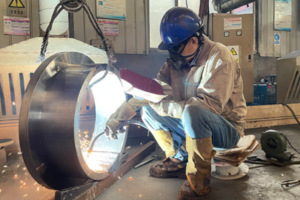
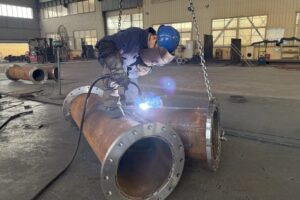
Installation and welding
- Remove rust, oil, and moisture before welding
- Pre-bake and preheat special welding consumables when required
- Use low-hydrogen electrodes to control heat input
- Plasma cutting or waterjet cutting is recommended
- Avoid stress concentration during bending and forming
- On-site hardfacing of high-chromium cast iron components is not recommended
Operation and maintenance
- Fine surface cracking is a normal stress-relief phenomenon
- Through-cracks or large-scale cracking indicate quality issues
- Regular inspections should focus on:
- Chutes
- Hoppers
- Conveyor systems
- Fan housings
- Repair wear layers before full wear-through occurs
- Proper maintenance can extend service life by 3–8 times
- High-hardness overlay layers are not suitable for conventional machining